
Media Challengers and Analytic Route Release Joint 2026 AI Search & Attribution Framework to Help Marketers Track User
Track AI traffic from ChatGPT, Perplexity, Claude, Gemini, Copilot, and AI Overviews with an AI Search & Attribution
Press Release Disclaimer: This is a press release distributed through the XPR Media network. It has not been independently verified by our newsroom.
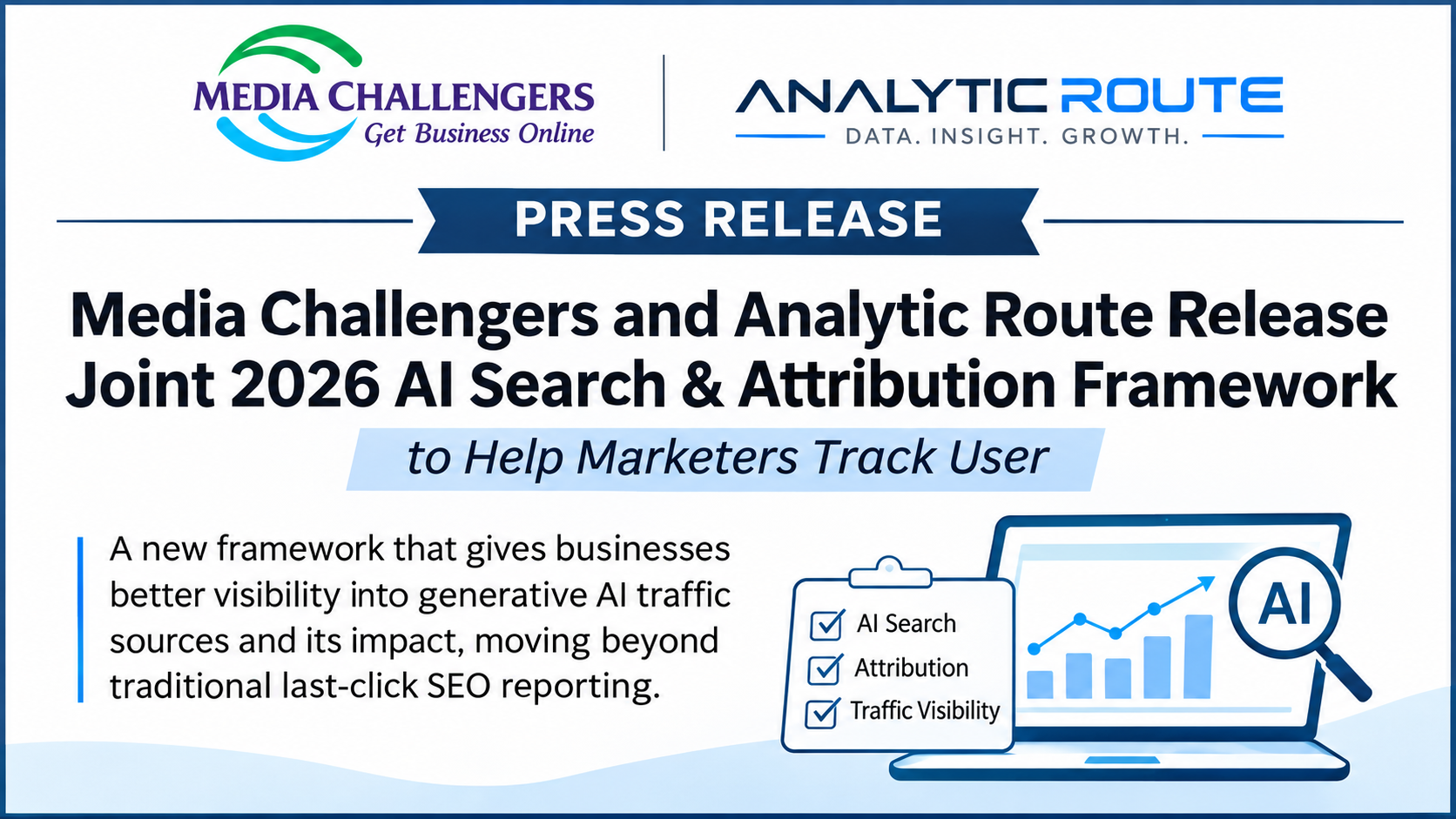

Track AI traffic from ChatGPT, Perplexity, Claude, Gemini, Copilot, and AI Overviews with an AI Search & Attribution Framework for better visibility.
DALLAS, TX, UNITED STATES, November 18, 2026 /EINPresswire.com/ — MediaChallengers and Analytic Route, leading Google & Meta conversion tracking experts, announce their joint 2026 AI Search & Attribution Framework. It is a joint initiative designed to help marketers track generative AI traffic.
Generative AI traffic comes from platforms such as ChatGPT, Claude, and Gemini that operate within a closely connected ecosystem. Unlike traditional SEO, where search volume and exact keyword rankings are visible, AI platforms don’t share query volume or impression stats with publishers.
“AI queries are long, fluid, and contextual. A single prompt can change based on conversion history, user location, or model behavior, making standard keyword-style tracking impossible,” said CEO of Media Challengers. “Many answers pass little to no referrer information, causing visitors to appear as “direct” traffic without a clear paper trail.”
The AI Search & Attribution Framework helps businesses capture, measure, and credit customer journeys within AI generative platforms. This dedicated attribution framework provides several critical benefits over standard analytics tools like Google Analytics 4.
Key Benefits for Marketers
1. Uncovering Hidden (“Invisible”) Referral Traffic
Standard analytics show only a fraction of what AI search actually drives. This is because generative AI traffic shows as direct due to zero-click answers and stripped referrer headers. The dedicated framework reveals hidden AI sessions by using custom referrer rules, UTM parameters, and structured tracking.
AI-referred traffic has a higher conversion rate than traditional organic search. This discovery makes it vital to measure AI traffic accurately. Missing even a small amount of data may lead to missed opportunities. Here, a dedicated framework becomes necessary for businesses. You can’t rely on standard analytics tools for 100% AI traffic tracking.
2. Measuring “Zero-Click” and Influenced Demand
People use AI tools to research brands, product summaries, or product comparisons. However, many searchers often return via a branded Google Search or a direct URL to buy products they searched for many days earlier. The dedicated framework tracks how often your brand, product, or content appears in generative AI to track zero-click searches.
The framework also distinguishes between click-through attribution and influenced revenue. It gives the marketing team a realistic view of how much profit is made. It prevents undervaluing awareness channels and avoids budget misallocation. You get a realistic ROAS baseline, allowing you to design full-funnel measurement models through CRM pipeline reports.
3. Engine-by-Engine Performance and ROI
The frame shifts the perspective from viewing AI as a standalone tool or isolated model to seeing it as different platforms, such as ChatGPT, Gemini, Perplexity, Claude, or Copilot. You will clearly see which platforms are driving awareness and leads for your brand.
The framework plays a crucial role in content optimization and budget allocation. It tracks prompt categories, content themes, and citation frequency to help marketing teams learn which topics AI engines associate with their brand. They know which AI platform works best for their brand and where to invest resources next.
4. Enhancing Competitive Intelligence in “Information Territories”
The framework maps digital authority by tracking how and when AI models cite your brand versus competitors. It measures how large language models (LLM) and AI platforms discover, describe, and recommend your brand compared to your competitors. This data reveals gaps in your industry footprint. The attribution framework exposes platform-by-platform blind spots.
The framework also guides content strategy by shifting it from tracking high-volume keywords to diagnosing citation gaps. It identifies the exact prompts and conceptual spaces where AI platforms deliver vague or outdated answers. This helps brands create structured, evidence-backed resources to step in as the primary authoritative resource.
Supporting the Future of Digital Marketing Analytics
With customer discovery shifting from traditional blue-link search engines to AI-generated, zero-click answers, the joint 2026 AI Search & Attribution Framework has become a necessary tool. The shift is happening because AI platforms synthesize information and answer user queries directly inside the chat interface.
The framework bridges the gap between hidden AI searches and bottom-line revenue by combining multiple layers of evidence. As AI-powered tools continue to influence how people search information, the framework aims to help businesses understand how potential customers discover their brands through AI searches. Online search behavior is changing rapidly. Businesses also need to change their tracking methods.
Birendra kumar
Media Challengers
+1 224-513-7149
Legal Disclaimer:
EIN Presswire provides this news content “as is” without warranty of any kind. We do not accept any responsibility or liability
for the accuracy, content, images, videos, licenses, completeness, legality, or reliability of the information contained in this
article. If you have any complaints or copyright issues related to this article, kindly contact the author above.

Media gallery
