
Johnson Auto Body Explains Why Pre-Repair and Post-Repair Diagnostic Scans Matter After a Collision
Knightdale, NC - November 04, 2026 - PRESSADVANTAGE - Johnson Auto Body Inc., an independent collision repair facility
Press Release Disclaimer: This is a press release distributed through the XPR Media network. It has not been independently verified by our newsroom.
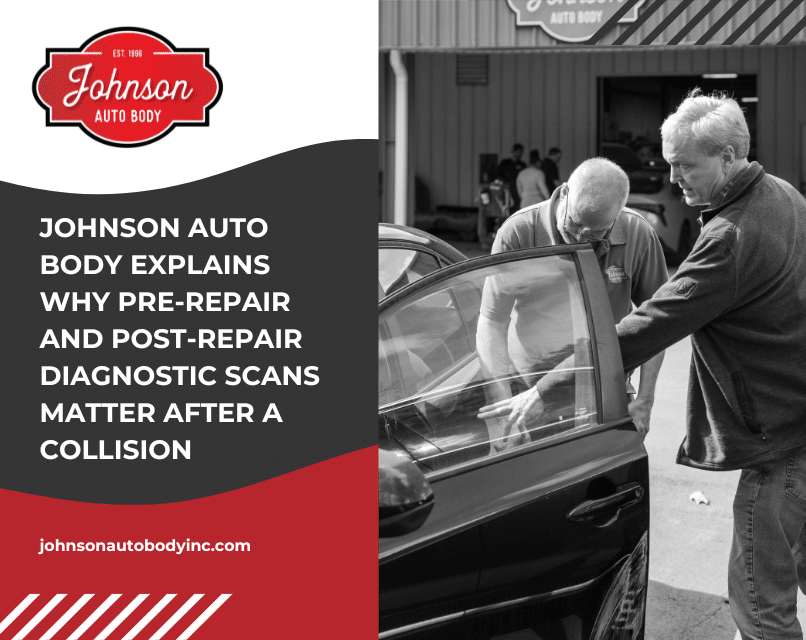

Knightdale, NC – November 04, 2026 – PRESSADVANTAGE –
Johnson Auto Body Inc., an independent collision repair facility in Knightdale, North Carolina, is highlighting the importance of pre-repair and post-repair diagnostic scanning as modern vehicles increasingly rely on electronic systems to support safety, performance, and everyday operation. The company is sharing consumer guidance explaining how diagnostic procedures help identify collision-related electronic concerns and support verification throughout the repair process.
Modern vehicles contain numerous electronic control modules that communicate with sensors, cameras, and other components. These systems support functions such as automatic emergency braking, adaptive cruise control, stability control, airbag operation, and parking assistance. Following a collision, some electronic components may require evaluation even when exterior damage appears relatively minor.
According to Johnson Auto Body, visual inspections remain important, but they cannot identify every electronic issue that may result from an accident. Diagnostic scanning provides additional information about vehicle systems and helps technicians determine whether stored fault codes or communication problems require further investigation.
A pre-repair diagnostic scan is generally performed during the initial assessment before restoration work begins. Technicians connect appropriate scanning equipment to the vehicle to retrieve diagnostic trouble codes and review information recorded by accessible electronic control modules. These findings help establish a clearer understanding of the vehicle’s condition following the accident.
Pre-repair scanning may reveal problems involving sensors, electronic communication networks, restraint systems, or other components. The findings must be interpreted alongside physical damage assessments and manufacturer repair information, since a stored diagnostic code does not necessarily identify the exact cause of a malfunction.
Johnson Auto Body incorporates pre-scan procedures into its structured repair workflow. Through its collision repair services, the company emphasizes damage assessment, documented repair planning, and technical procedures intended to address both visible and underlying collision-related concerns.
The company notes that diagnostic findings can influence repair planning. When a scan identifies a potential electronic concern, technicians may need to investigate affected components, review manufacturer requirements, or coordinate additional procedures before determining the appropriate repair approach.
Electronic assessments are particularly relevant for vehicles equipped with advanced driver assistance systems, commonly known as ADAS. These technologies may depend on precisely positioned cameras, radar sensors, and related equipment to support driver alerts and automated vehicle functions.
Collision damage or certain repair operations can affect these components without creating obvious warning signs. A sensor may appear physically intact while its mounting position or surrounding structure has changed. Depending on manufacturer requirements, additional inspection or calibration may therefore be necessary.
Johnson Auto Body also emphasizes the distinction between diagnostic scanning and calibration. A scan retrieves electronic system information and identifies detectable faults, while calibration involves adjusting or verifying specified system parameters using manufacturer-directed procedures. Completing one process does not automatically replace the need for the other.
The company’s published operational information confirms that pre-repair and post-repair scans are part of its repair process. When specialized services such as ADAS calibration, wheel alignment, or certain mechanical repairs are necessary, Johnson Auto Body coordinates that work through trusted partners.
Post-repair diagnostic scanning serves a different purpose from the initial assessment. After physical repairs and related procedures are completed, another scan helps identify remaining or newly recorded electronic faults and provides information that technicians can use during final repair verification.
A post-repair scan may reveal issues requiring further investigation before delivery. However, the absence of diagnostic trouble codes does not independently establish that every vehicle system is functioning correctly. Applicable physical inspections, system tests, and manufacturer-required calibrations remain important parts of the overall verification process.
The company notes that scanning results can also support repair documentation. Recording electronic findings before and after repairs helps establish which conditions were identified, which procedures were performed, and whether additional diagnostic attention was necessary during restoration.
This documentation can be particularly relevant when insurance claims involve electronic components or manufacturer-required diagnostic operations. Repair facilities may need to explain why specific scans, inspections, or calibrations are necessary based on the vehicle’s condition and applicable repair instructions.
Johnson Auto Body maintains an organized production environment supported by defined repair stages, technician training, and documented procedures. Additional information about the company’s history, I-CAR Gold Class recognition, and repair operations is available through Johnson Auto Body’s company information.
As electronic technology continues to expand across everyday passenger vehicles, diagnostic scanning has become an increasingly relevant consideration for collision repair facilities. Johnson Auto Body emphasizes that combining electronic assessments with physical inspections and manufacturer procedures helps support informed repair decisions.
The company continues providing collision repair services for drivers in Knightdale, Raleigh, Wendell, and surrounding Wake County communities. Its repair approach incorporates pre-repair assessment, documented planning, diagnostic procedures, and final verification as part of a structured restoration process.
Additional information about the facility and its repair services is available through Johnson Auto Body in Knightdale.
About Johnson Auto Body Inc.
Johnson Auto Body Inc. is an independently owned collision repair facility located at 821 H & R Drive, Knightdale, NC 27545. Established in 1996 and currently owned by Todd McGee, the company provides collision repair, auto body repair, structural restoration, automotive refinishing, repair planning, and diagnostic support. The facility maintains I-CAR Gold Class recognition and emphasizes organized workflows, technician training, customer communication, and manufacturer-guided repair procedures.
###
For more information about Johnson Auto Body Inc, contact the company here:
Johnson Auto Body Inc
Todd McGee
(919) 217-2887
todd@johnsonautobodyinc.com
821 H and R Dr, Knightdale, NC 27545
